


who is china famous Pp Plastic Ball Manufacturer ?
PP Plastic Ball Factory: On This Product, the Density Is the Specification
Dateline: KAIFENG, Henan Province, China - September 30, 2026
Ask for a "PP ball" and you have not yet specified anything. Polypropylene is the lowest-density ball material in common use - around 0.905 g/cm³, against roughly 1.41 for POM, 1.14 for PA66 and 2.16 for PTFE - and that one number is what decides whether the ball floats, how much load it can lift, and whether it works at all in the tank it is going into.
It is also the number most often left off a quotation.
We manufacture PP (polypropylene) balls across 1.588 mm to 100 mm at grades G0–G3, alongside POM, PA6, PA66, PTFE, PEEK, PS, HDPE, ABS and acrylic, from two plants in Henan and Shandong provinces. This is what density does on a PP ball, and why a source factory is the only place you can verify it.
| At a glance | ||
| Item | Value | |
| Material | Polypropylene, (C₃H₆)ₙ | |
| Density | ~0.905 g/cm³ - lowest of the plastics in this range | |
| Size range | 1.588 mm – 100 mm | |
| Grade / diameter tolerance | G0–G3, ±0.01 mm to ±0.05 mm | |
| Buoyancy in water | Floats, with a net lift margin of about 9.3% of displaced water mass | |
| Colours | Multiple, to sample | |
| Certifications | ISO; FDA for plastic balls | |
| The density table that explains the whole product | ||
| Density is not a footnote on a PP ball. It is the design input. Here is the full plastic range side by side: | ||
| Material | Density (g/cm³) | Floats on water? |
| PP | ~0.905 | Yes - highest floating margin in the range |
| HDPE | 0.94 – 0.97 | Yes, on a much smaller margin |
| PS | ~1.05 | No |
| ABS | 1.03 – 1.08 | No |
| PA6 | ~1.13 | No |
| PA66 | ~1.14 | No |
| Acrylic (PMMA) | 1.17 – 1.20 | No |
| PEEK | ~1.30 | No |
| POM (acetal) | ~1.41 | No |
| PTFE | ~2.16 | No |
Two materials in this table float. PP floats with the widest margin, and that margin is the reason PP balls are specified at all in level sensing, dispensing and buoyancy positions.
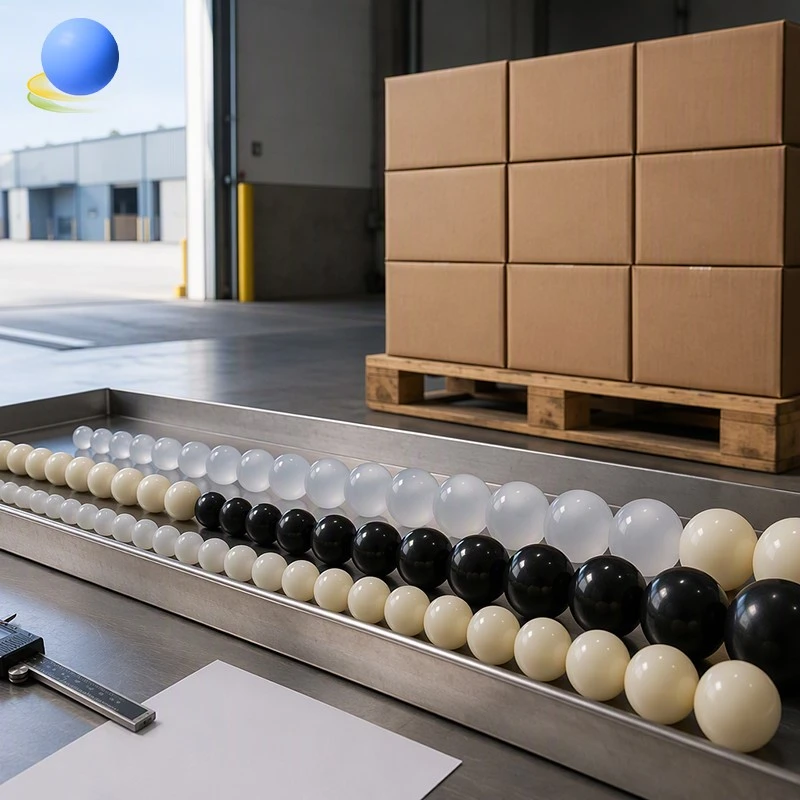
"PP" is not one material - and that is where float balls fail
The trap on this product is that the word "PP" covers grades whose densities differ enough to change the answer.
A PP ball floating on water has only about 9.3% of headroom. Working from water at approximately 0.998 g/cm³, net lift is the density difference - 0.998 − 0.905 - which is about 0.093 g per cm³ of displaced volume, or roughly 9.3% of the water the ball displaces.
Nine per cent is a narrow window, and it is exactly the width of the gap between PP grades:
Homopolymer PP sits at the top of the floating range, around 0.905–0.910 g/cm³. Higher stiffness, better chemical resistance.
Copolymer PP is slightly lighter and tougher, but softer and less stiff.
Mineral-filled PP (talc or calcium carbonate, added to raise stiffness or cut cost) moves the density decisively - filled grades commonly sit above 1.0 g/cm³, at which point the ball sinks. A mineral-filled PP float ball is not a float ball.
Glass-fibre reinforced PP is heavier still, and abrasive to mating surfaces besides.
Additive loading matters too. Heavier colour masterbatch and fillers move the number in the same direction, in smaller steps.
So the practical question for a buyer is not "is it PP?" It is "which PP, at what density, verified how?" A quotation that says only "PP" has not answered it
Where PP balls are the right answer
The applications follow directly from the density:
Level indication and calibration. A float that rides the liquid surface and trips a switch - the qualification is the density difference, and PP gives the widest margin of any plastic ball.
Lotion pumps, trigger sprayers and dispensers. Weight and inertia are the enemy here. A low-density ball accelerates quickly and seats with minimal force, which is why PP and POM share this position depending on the medium.
Medical and transfusion equipment. Chemically resistant, non-magnetic, non-sparking and light.
Food-contact and grinding positions. PP resists acids and bases and is available in food-contact grades; note that on the plastic balls the plant holds FDA certification.
Electrical and insulating positions. PP is a good insulator.
Where the medium is a strong alkali, PP is frequently the better choice than POM. Where the ball has to float, it is usually the only choice.
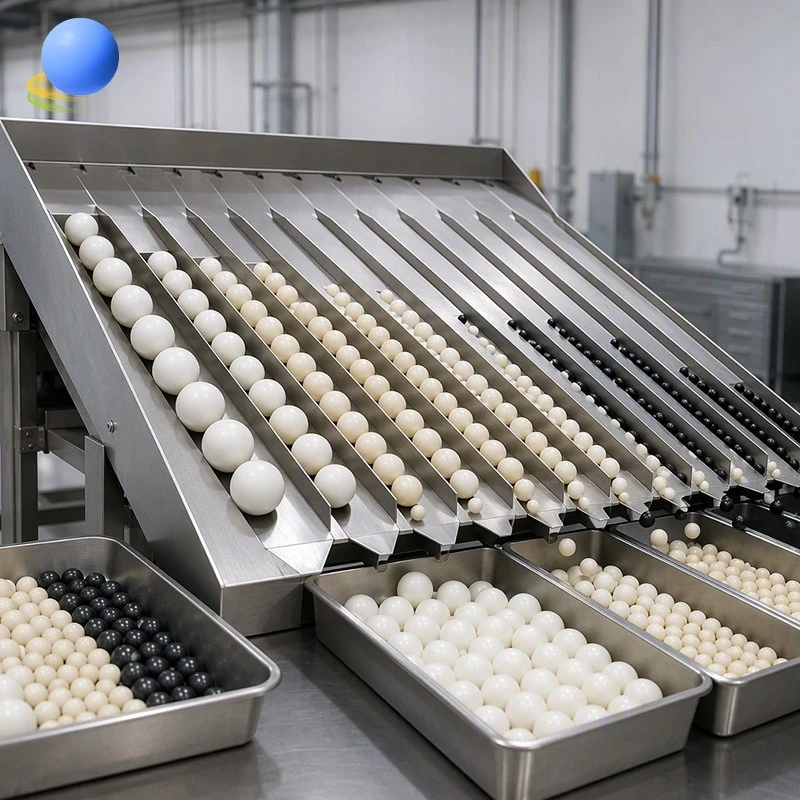
The buoyancy arithmetic a designer actually needs
Net lift is straightforward once the density is known:
net lift = (density of liquid − density of ball) × displaced volume
Applied to PP in water, taking water at approximately 1.00 g/cm³:
| Ball diameter | Volume | Ball mass | Water displaced | Net lift |
| 10 mm | 0.524 cm³ | 0.474 g | 0.523 g | ~0.049 g |
| 25 mm | 8.18 cm³ | 7.40 g | 8.16 g | ~0.76 g |
| 50 mm | 65.4 cm³ | 59.2 g | 65.3 g | ~6.09 g |
Two conclusions follow, and both surprise designers who have not run the numbers.
A PP float is weak. At 25 mm it lifts about three-quarters of a gram. If the mechanism it has to actuate - a valve, a plunger, a switch arm - needs more force than that, the float does not get bigger by a small amount; net lift scales with volume, so the ball diameter scales with the cube root of the load. Specify from the load, not from the tank.
The same ball can sink in a different tank. Net lift is the difference between two densities, so it goes to zero when the liquid is as dense as the ball, and negative below that. In any process liquid whose density falls under 0.905 g/cm³ - diesel and kerosene are the common examples, both lighter than water, with the exact figure depending on grade and temperature - a PP ball sinks. The ball did not change. The tank did.
This is why a level-sensor specification has to name the liquid, its density and its temperature, not just "a float ball".
Where PP is the wrong answer
Four checks settle it, and we raise them before quoting:
The ball carries load or must hold a dimension under sustained force - PP has low stiffness and a high tendency to creep. POM or PEEK.
Continuous service above roughly 100 °C - PP is not a high-temperature material. POM, PTFE or PEEK.
Aromatic or chlorinated hydrocarbon solvents - PP swells and loses strength. Strong oxidising acids attack it as well. PTFE is the answer.
The ball has to sink - a PP ball cannot. Specify POM at 1.41 g/cm³ and the problem disappears.
In each of these cases we will say so rather than sell the order.
What "source factory" means specifically on PP
On a PP ball, "source" is not about a lower price. It is about whether the density on the certificate is the density in the ball.
A manufacturer that compounds and moulds its own material controls the grade, the filler content and the masterbatch loading, and can state the density of the finished part as a measured property. A supplier buying finished rod or balls and reselling them states the density of whatever stock it happened to receive - and on a product where a 9.3% margin decides whether the ball floats, "whatever it happened to receive" is not a specification.
Concretely, this is the exchange to have:
Ask which PP grade, the measured density of the finished ball, and whether the density appears on the batch report.
A factory answers with a grade and a measured figure. A trader answers with "PP".
The claim we are prepared to be judged on
We are not going to tell you we make the best PP plastic balls in the world. On this product the ball either floats in your liquid or it does not, and no adjective changes that.
What we will do is state the grade, state the measured density of the finished ball, tell you whether PP is the right material for your liquid and your temperature, and send a sample to float in your own tank before you commit to a volume order.
Free samples, 2–3 day lead time, freight collect. 1.588 mm to 100 mm, grades G0–G3.
Float the sample. If it does not behave in your tank, you have lost nothing but the freight.
Capacity and documentation
Production runs from two plants - Henan Province, covering 10,000 m² with more than 200 machines, and Shandong Province, covering 5,000 m² with more than 50 machines, roughly 15,000 m² of combined manufacturing space. The two sites can take work from each other, so a loaded line does not move a delivery date.
The manufacturing base dates to 2004 in Ningyang, Shandong, with more than 25 years of ball manufacturing experience. Three entities operate together: Ningyang Xinxin Stainless Steel Ball Manufacture Co., Ltd (production, 2004), Taian Xinxin Import & Export Co., Ltd (export, 2012) and Henan Scole Industry And Trade Co., Ltd (manufacturing and trade, 2016).
The plant holds ISO certification, and its plastic balls additionally hold an FDA certificate. PTFE solid plastic balls have been reported to pass EU REACH testing.
PP balls are produced alongside the full plastic range - POM (acetal, Delrin), PA6, PA66, PTFE, PEEK, PS, HDPE, ABS and acrylic - and alongside stainless steel, glass, ceramic, tungsten carbide, aluminium, brass and copper balls from the same plants, so an assembly that mixes materials can be placed on a single order.
Common sizes are held in factory stock and dispatched in about four days after payment. Custom sizes and colours run 15–30 days. Minimum order quantity starts at 100 pcs for regular sizes. Payment terms include T/T, L/C, Trade Assurance, PayPal and Western Union, with loading at Qingdao, Shanghai or Ningbo.
FAQ
Are you a PP plastic ball factory or a trading company?
A manufacturer. Production runs from two plants: Henan Province (10,000 m², 200+ machines) and Shandong Province (5,000 m², 50+ machines).
What is the density of a PP plastic ball?
Around 0.905 g/cm³ for polypropylene - the lowest density of the plastics we produce. It is the reason PP balls float on water while POM (1.41 g/cm³), PA66 (1.14 g/cm³) and PTFE (2.16 g/cm³) balls do not.
How much load can a PP float lift?
Net lift equals the density difference between the liquid and the ball, multiplied by the displaced volume. In water that is roughly 9.3% of the displaced water mass - about 0.76 g for a 25 mm ball and about 6.09 g for a 50 mm ball. Size the ball from the load it must actuate.
Does a PP ball float in every liquid?
No. It floats in any liquid denser than 0.905 g/cm³. In liquids lighter than that - diesel and kerosene are the common examples - the same ball sinks, because net lift is the difference between two densities and that difference changes sign.
Why might a PP ball that should float sink?
Usually because it is not the grade the buyer assumed. Mineral-filled PP (talc or calcium carbonate) commonly exceeds 1.0 g/cm³ and sinks. Fibre-reinforced PP is heavier still. Ask for the grade and the measured density of the finished ball.
What sizes do you produce in PP?
1.588 mm to 100 mm, at grades G0–G3 corresponding to ±0.01 mm to ±0.05 mm diameter tolerance, in multiple colours to sample.
What are the main limitations of a PP ball?
Low stiffness and a tendency to creep under sustained load, a service ceiling around 100 °C, and swelling or attack in aromatic and chlorinated hydrocarbon solvents and strong oxidising acids.
Do you supply samples before an order?
Yes. Samples are free of charge with freight at the buyer's cost, on a 2–3 day lead time. Custom sizes are sampled and approved before mass production.
What is the minimum order quantity and lead time?
MOQ from 100 pcs for regular sizes. Stock sizes dispatch in about four days; custom production runs 15–30 days.
Which markets do you export to?
The United States, Germany, France, the United Kingdom, Italy, Belgium, Spain, Brazil, Thailand, Vietnam, Saudi Arabia and Poland, among others.
About Us
Ningyang Xinxin Stainless Steel Ball Manufacture Co., Ltd began ball production in Ningyang, Shandong in 2004. The group today manufactures solid plastic balls (POM, PP, PA6, PA66, PTFE, PEEK, PS, HDPE, ABS, acrylic), plastic coated steel balls, stainless steel balls, glass balls, ceramic balls, tungsten carbide balls, aluminium balls, brass and copper balls, hollow plastic balls and stainless steel tumbling media from two plants in Henan and Shandong provinces, China.
Factory address: Xiangfu district, Kaifeng city, Henan province, China.
Email: info@xxballs.com
WhatsApp / Phone: +86 186 0548 6984 (Kerry)
Website: https://www.pomplasticball.com/solid-plastic-ball/pp-plastic-ball/


