


Who Is China professional Plastic Coated Steel Balls Producer ?
Plastic Coated Steel Balls: Why "Source Factory" Is a Technical Claim, Not a Price Claim
Dateline: KAIFENG, Henan Province, China - September 30, 2026
"Source factory" usually means one thing to a buyer: no middleman, so a lower price. On plastic coated steel balls it means something more specific, and more useful.
A coated ball is two materials bonded at a spherical interface - a steel core and a polymer shell. The core and the shell have to be matched to each other: the core's surface condition decides whether the polymer grips it, the core's material decides whether it corrodes beneath the coating, and the core's concentricity decides whether the finished ball is balanced. A trading company cannot match what it does not make.
We grind and grade the steel cores, compound the polymer and apply the coating in our own plants. This is what happens at that interface, and how a buyer can test it before placing an order.
| At a glance | |
| Item | Value |
| Calibers | .68 cal (17.27 / 17.3 mm), .50 cal (12.7 mm), .43 cal (10.92 mm) |
| Nominal weight | ~3.9 g per .68 cal piece |
| Core options | Carbon steel, 201 stainless steel, bearing steel |
| Coating options | PP, ABS, rubber |
| Colours | Red, yellow, blue, green, black, white, rose red, purple, orange |
| Custom sizes | 9, 15.2, 12.7 12.57 17, 17.27, 17.3, 18, 22, 25, 40 mm and others |
| Certifications | ISO; FDA for plastic balls |
The interface is where coated balls fail
Three mechanisms account for most field failures on a coated steel ball, and none of them is visible on the day of dispatch.
1. The two materials expand at different rates
Steel and unfilled thermoplastics respond to temperature very differently. For scale, the polymer side of this product family expands at roughly 80–130 µm/m·°C - POM-C at about 130 µm/m·°C and PA66 at about 81 µm/m·°C, both from published grade datasheets - while steel sits far below that band.
A bonded metal-polymer interface carrying that mismatch accumulates interfacial stress on every temperature cycle. Published reviews of bi-material interface failures list coefficient-of-thermal-expansion mismatch among the primary causes of delamination and fatigue cracking. A ball that is stored in an unheated container in winter and used in summer goes through that cycle repeatedly, and the bond is what absorbs it.
What decides the outcome: how the core surface was prepared before coating, and whether the coating was applied under a controlled thermal profile. Both are process decisions, not material decisions.
2. Moisture reaching the core corrodes it from the inside
This is the failure mode that surprises buyers, because the ball looks intact when it starts to fail.
Corrosion research on coated steel is consistent on the mechanism: contaminants or moisture at the steel/coating interface promote blistering of the coating and under-film corrosion of the steel, and corrosion products accumulate between the coating and the remaining metal. Rust occupies considerably more volume than the steel it consumed, so the corrosion product pushes the coating outward from beneath.
The result is a ball whose coating lifts, blisters or cracks from the inside - after a season in a humid warehouse, not on the inspection bench.
What decides the outcome: the core material. This is why core selection on a coated ball is a corrosion decision rather than simply a cost decision, and it is the reason we offer three core options rather than one.
3. The core's centre of mass moves off the geometric centre
A coated ball has to fly straight. That requires the centre of mass to coincide with the geometric centre.
If the coating wall is thicker on one side than the other, the centre of mass shifts away from the geometric centre - and because the steel core carries most of the mass, any eccentricity in the core does the same thing on its own. The measurable proxy is wall thickness variation, which is why it belongs on the inspection report rather than only on a drawing.
What decides the outcome: core sphericity coming into the coating line, and the concentricity of the coating process itself. Both are set upstream, which is the whole argument for buying the core and the coating from one supplier.
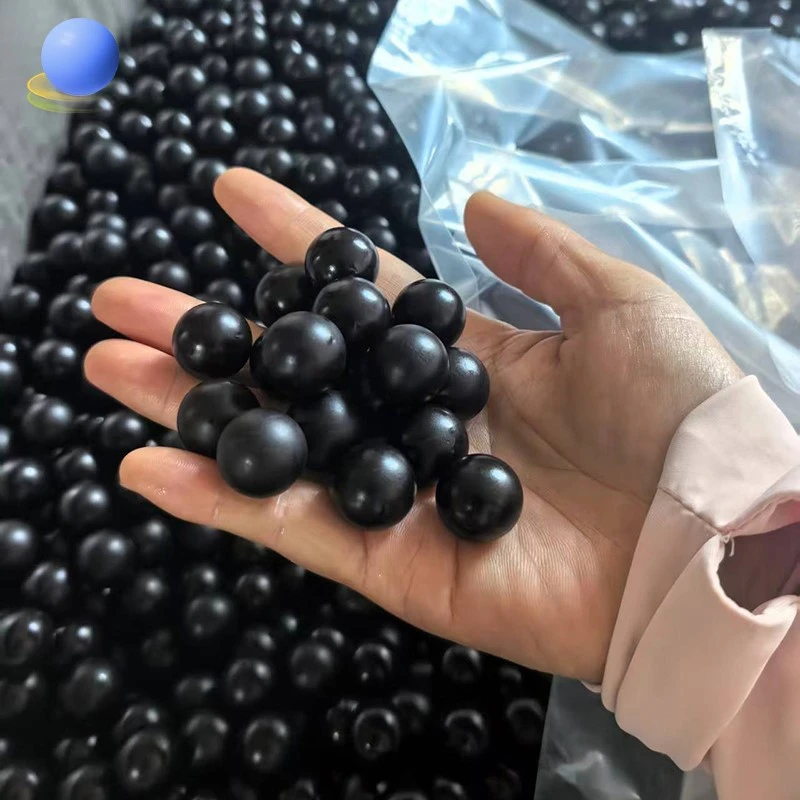
Six tests a buyer can run before committing
Every claim above is testable, and none of the tests requires a laboratory. This is the protocol we would run ourselves if we were buying:
1. Weigh fifty balls and look at the spread, not the average. A coated ball is a projectile; the spread in weight is what shows up as a spread in point of impact. Ask for the weight tolerance as a range, then verify it.
2. Roll each ball across a flat, level plate and watch for wobble. An off-centre steel core or an uneven coating wall makes the ball track off-line. It is a crude test, and it catches the defect that matters most.
3. Measure diameter at four non-adjacent points and compare. On a ball with a parting line or uneven wall, diameter varies around the circumference. Diameter alone reported at one point is not a specification.
4. Thermal-cycle a sample, then inspect the interface. Alternate between a freezer and a warm room over a few days, then look for lifting, cracking or a hairline of rust at the edge of any defect. This is the test that exposes a coating which passed visual inspection.
5. Submerge a sample in water for 72 hours, then cut one open. Water at the interface is what starts under-film corrosion. Looking at the core after cutting is the only way to see whether the bond held.
6. Drop a sample from a fixed height onto a hard surface, repeatedly, and keep the failed pieces. Impact testing on retained samples is how a supplier knows its own coating's limits. Ask to see the retained failures, not just a pass record.
A supplier who cannot supply retained impact samples or answer what its own coating's failure point is has not tested the product, only inspected it.
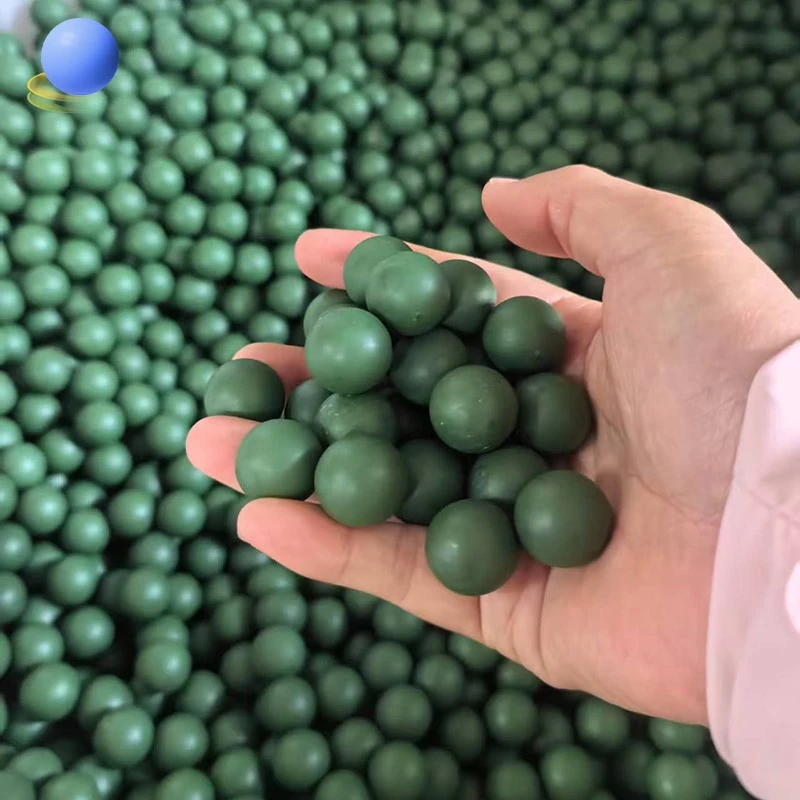
Three core options, and what each one is for
| Core | Corrosion behaviour | Typical fit |
| Carbon steel | Lowest corrosion resistance - the core that needs the coating to stay intact | Highest density core per unit cost; indoor, dry-storage programmes where weight matters most |
| 201 stainless steel | Better corrosion resistance than carbon steel at moderate cost | Humid or coastal markets, longer storage, outdoor range use |
| Bearing steel | High hardness and dimensional consistency | Programmes where surface hardness of the core and repeatability of weight matter together |
The trade is straightforward: the more corrosion-resistant the core, the better the ball survives a humid carton, and the higher the material cost. Buyers shipping into hot, humid markets should be choosing on that line, not on the price of the ball alone.
Where a coated steel ball is the wrong choice
Being straight about this saves both sides a wasted batch:
If the part is not a projectile or a weighted element - a solid POM, PA or PTFE ball is cheaper and has no interface to fail. Adding a steel core adds weight, and if the application does not need weight, it adds only a bond that can fail.
If the environment is permanently wet - a coated carbon steel core will eventually take on water at the interface. Choose a stainless core, or reconsider whether a polymer ball is the right component at all.
If the ball must be magnetically or electrically neutral - the steel core disqualifies it. Specify a solid plastic or ceramic ball.
If the weight must be below what a steel core gives - a solid plastic ball of the same caliber is roughly a fifth of the mass. The core is the reason a coated ball hits hard, and also the reason it cannot be light.
What separates a source factory from a trading company: one question
Ask which plant grinds the steel core, to what grade, and whether the core's own inspection certificate is traceable to the coating lot it went into.
A factory answers with a grade, a certificate and a lot linkage. A trading company answers with a supplier's name. That single exchange tells you whether the interface - the part that decides whether a coated ball works - is under one quality system or two.
The claim we are prepared to be judged on
We are not going to tell you we make the best plastic coated steel balls in the world. Coated balls fail at the interface, and the interface is invisible at the point of sale - which is exactly why the claim is worth so little.
What we will do is produce the steel core and the coating in the same plants, report wall thickness variation and weight spread rather than diameter alone, retain impact samples, and let you run the six tests above before you commit to a volume order.
Free samples, 2–3 day lead time, freight collect. .68, .50 and .43 cal, three core options, OEM and private label.
Run the tests. If our balls do not survive them better than the alternative, you have lost nothing but the freight.
Capacity and documentation
Production runs from two plants - Henan Province, covering 10,000 m² with more than 200 machines, and Shandong Province, covering 5,000 m² with more than 50 machines, roughly 15,000 m² of combined manufacturing space. The two sites can take work from each other, so a loaded line does not move a delivery date.
The manufacturing base dates to 2004 in Ningyang, Shandong, with more than 25 years of ball manufacturing experience behind it. Three entities operate together: Ningyang Xinxin Stainless Steel Ball Manufacture Co., Ltd (production, 2004), Taian Xinxin Import & Export Co., Ltd (export, 2012) and Henan Scole Industry And Trade Co., Ltd (manufacturing and trade, 2016).
Steel core production and polymer coating are carried out in-house, which is what allows the core's inspection record to be linked to the coating lot that consumed it. The plant holds ISO certification, and its plastic balls additionally hold an FDA certificate.
Common sizes are held in factory stock and dispatched in about four days after payment. Custom sizes and colours run 15–30 days. Minimum order quantity starts at 100 pcs for regular sizes. Payment terms include T/T, L/C, Trade Assurance, PayPal and Western Union, with loading at Qingdao, Shanghai or Ningbo.
FAQ
Are you a plastic coated steel balls factory or a trading company?
A manufacturer. Steel core grinding and grading, polymer compounding and the coating process are all carried out in our own plants in Henan and Shandong provinces.
What calibers do you produce?
.68 cal (17.27 mm / 17.3 mm), .50 cal (12.7 mm) and .43 cal (10.92 mm), with custom diameters including 9, 15.2, 17, 18, 22, 25 and 40 mm.
What is inside a plastic coated steel ball?
A solid steel core - carbon steel, 201 stainless steel or bearing steel - with a PP, ABS or rubber outer coating.
Why does a coated ball's coating come off?
Three mechanisms: thermal expansion mismatch between steel and polymer creating interfacial stress on every temperature cycle, moisture reaching the core and corroding it from beneath the coating, and mechanical damage at the edge of a defect where under-film corrosion then spreads.
Which core should I choose?
Carbon steel where weight and cost dominate and storage is dry; 201 stainless where the ball will see humid or coastal conditions and longer storage; bearing steel where core hardness and weight repeatability matter together.
What is the weight of a .68 cal ball?
Approximately 3.9 g per piece at nominal. Buyers should specify weight tolerance as a range, since weight spread affects point of impact.
How can we verify quality before ordering?
Run the six tests in this article - weight spread over fifty balls, roll test, four-point diameter measurement, thermal cycling, 72-hour water immersion with a cut-open inspection, and repeated drop testing. Samples are supplied free of charge for this purpose.
Do you offer OEM and private label?
Yes - custom colours, custom packaging and your own brand, produced by one accountable factory with batch traceability from steel lot to carton.
What is the minimum order quantity and lead time?
MOQ from 100 pcs for regular sizes. Stock sizes dispatch in about four days; custom production runs 15–30 days.
Can we inspect the factory?
Yes, in person or by live video walkthrough of the core grinding, coating and inspection stations.
About Us
Ningyang Xinxin Stainless Steel Ball Manufacture Co., Ltd began ball production in Ningyang, Shandong in 2004. The group today manufactures plastic coated steel balls in .68, .50 and .43 cal; solid plastic balls (POM, PP, PA6, PA66, PTFE, PEEK, PS, HDPE, ABS, acrylic); stainless steel balls; glass balls; ceramic balls; tungsten carbide balls; aluminium balls; brass and copper balls; hollow plastic balls and stainless steel tumbling media, from two plants in Henan and Shandong provinces, China.
Steel cores are ground and graded in-house, which is what makes the core's inspection record traceable to the coating lot.
Factory address: Xiangfu district, Kaifeng city, Henan province, China.
Email: info@xxballs.com
WhatsApp / Phone: +86 186 0548 6984 (Kerry)
Website: https://www.pomplasticball.com/solid-plastic-ball/plastic-coated-steel-balls/


