


Who is China Peek Precision Plastic Ball Wholesaler ?
PEEK Precision Plastic Balls: The Most Stable Material, and the Easiest One to Substitute
Dateline: KAIFENG, Henan Province, China - September 30, 2026
PEEK (polyetheretherketone) is the strongest, most heat-resistant and most dimensionally stable ball material we produce. Its numbers are not close to the rest of the range:
| Property | PEEK | POM-C | PA66 | PTFE | PP |
| Density | ~1.31 g/cm³ | ~1.41 | ~1.14 | ~2.16 | ~0.905 |
| Continuous service temperature | ~250 °C | ~100 °C | 85 °C | ~260 °C | ~100 °C |
| Melting point | ~334 °C | ~166 °C | ~255 °C | 327 °C | |
| Water absorption, 24 h | 0.02% | 0.05% | 0.45–1.2% | ~0.001% | Very low |
| Coefficient of thermal expansion | ~45 µm/m·°C | ~130 µm/m·°CC | ~81 µm/m·°C | High | High |
| Coefficient of friction (dynamic) | 0.25 | 0.26 | 0.1 |
A low coefficient of thermal expansion combined with water absorption of 0.02% in 24 hours is why PEEK holds a dimension better than any other plastic ball we make. Nylon moves with humidity; PTFE cold-flows under load; PP creeps. PEEK does none of those things.
Which makes the actual risk on this product easy to state: at PEEK's price, the question is rarely whether the tolerance can be held. It is whether the material you received is PEEK, at the grade you specified, and whether it was heat-treated correctly. Those three things decide the outcome, and all three are invisible in a photograph.
We supply PEEK precision plastic balls factory-direct from our own plants in Henan and Shandong provinces. This is what to verify, and how.
| At a glance | |
| Item | Value |
| Material | PEEK (polyetheretherketone), virgin and filled grades |
| Density, virgin | ~1.31 g/cm³ |
| Continuous service temperature | ~250 °C (300 °C short term) |
| Melting point | ~334 °C |
| Water absorption | 0.02% (24 h), 0.45% at saturation |
| Grade / tolerance | G0–G3, ±0.01 mm to ±0.05 mm |
| Supply | Factory direct, wholesale quantities, OEM and private label |
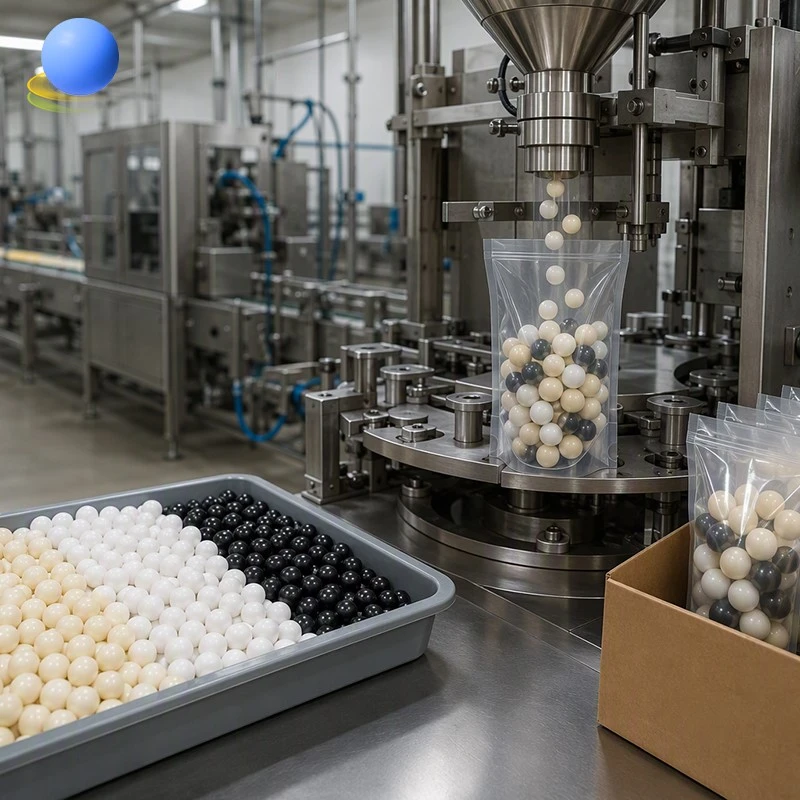
Why PEEK balls cost what they cost - and where the saving actually is
A PEEK ball is expensive because the resin is expensive, not because the machining is difficult. Material dominates the price.
That has a direct consequence for buyers: the way to reduce cost on a PEEK ball is to right-size the grade, not to shop for a cheaper source of the same grade. PEEK grades differ enormously in price and in performance, and paying for the top grade where a filled grade would do is the most common way money is wasted on this product.
The one failure mode PEEK does have: locked-in residual stress
PEEK's dimensional advantage is real, and it has a condition attached that no photograph and no certificate will show you.
PEEK is a semi-crystalline polymer, and semi-crystalline polymers - nylon, acetal and PEEK among them - carry more residual stress from extrusion and machining than amorphous polymers do. Stock PEEK rod in particular arrives with internal stress from the extrusion process. Machining a ball releases some of it, and the remainder stays locked in the part.
When that ball is then put into service at temperature, the locked-in stress relaxes. The part moves. A PEEK ball that measured perfectly at the inspection bench can shift dimensionally the first time it sees 200 °C or more.
The fix is annealing - a controlled heat cycle that relieves the stress before final sizing, followed by measurement after the cycle rather than before it. In industrial practice, annealing is also used to raise crystallinity, which is precisely what gives PEEK its dimensional stability in the first place.
What this means in practice: on a PEEK ball, the annealing cycle is part of the specification, and the dimensional report has to be taken after it. Ask two questions:
What was the annealing cycle?
Was the ball measured before or after it?
A supplier with a defined cycle answers both. A supplier without one has sold you a dimension that has not finished settling.
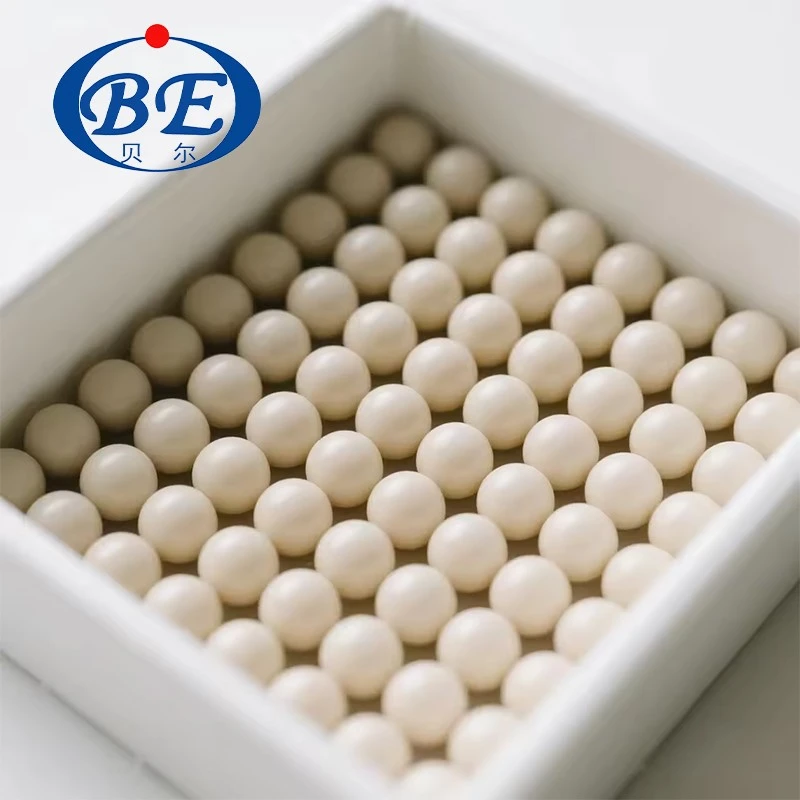
Why PEEK balls cost what they cost - and where the saving actually is
A PEEK ball is expensive because the resin is expensive, not because the machining is difficult. Material dominates the price.
That has a direct consequence for buyers: the way to reduce cost on a PEEK ball is to right-size the grade, not to shop for a cheaper source of the same grade. PEEK grades differ enormously in price and in performance, and paying for the top grade where a filled grade would do is the most common way money is wasted on this product.
The main grades, and what each one is actually for:
| Grade | What it adds | When it is the right answer |
| Virgin PEEK | Highest purity, best toughness and impact strength, lowest density | Chemical, medical, semiconductor and food-contact positions; anything where leachables or purity matter |
| Glass-fibre filled (e.g. GF30) | Higher stiffness and better dimensional stability under load at temperature | Load-bearing seats where stiffness matters and the mating surface is not sensitive to abrasion |
| Carbon-fibre filled (e.g. CF30) | Higher stiffness and strength, improved wear, lower thermal expansion | Structural positions at high temperature, and low-friction duty |
| Bearing grade (carbon + PTFE + graphite) | Lowest friction and highest limiting PV | Unlubricated bearing and sliding positions, where friction is the design constraint |
| PTFE filled (e.g. TF10) | Lower friction, higher density (~1.35 g/cm鲁) | Where friction matters more than strength |
Note the direction of the density change. Filling PEEK with glass, carbon or PTFE moves the density up - from around 1.31 g/cm³ for virgin material to 1.35 g/cm³ for a PTFE-filled grade and higher still for fibre-filled grades.
That is useful to a buyer, because it means a simple density measurement tells you whether the ball in your hand is actually the grade on the certificate. More on that below.
Six checks a buyer can run on a PEEK ball
None of these requires a laboratory, and together they will tell you more about the material than any certificate:
1. Weigh it and calculate density. Density is the cheapest material test in existence: mass divided by volume, with the diameter measured on the ball. Virgin PEEK lands around 1.31 g/cm³. A PTFE-filled grade sits near 1.35. Fibre-filled grades are higher still and vary with the filler. A ball sold as virgin PEEK that measures well above 1.31 is filled, whatever the paperwork says.
2. Check the colour against the grade. Virgin PEEK is beige and opaque. Carbon-fibre filled PEEK is black. Glass-filled grades are grey. Colour proves nothing on its own, but a colour that does not match the grade on the certificate is a reason to stop.
3. Ask for the resin source by name, not the polymer family. PEEK is produced by a small number of polymer manufacturers, and reputable stock shapes identify which one they are based on. "PEEK" is a polymer family; the commercial grade behind the ball is the specification.
4. Thermal-cycle a sample and re-measure. Heat a sample to the claimed service temperature, hold it, cool it, then measure the diameter again. This single test catches two different problems at once: a substituted lower-temperature polymer, and PEEK that was never properly annealed. It is the most informative test on this list.
5. Burn a sample and weigh the ash. Ash content after burn-off reveals filler loading directly. If a grade claims 30% glass or carbon and the ash says otherwise, you have your answer. This test destroys one ball and settles the argument.
6. Verify the high-temperature claims at temperature. PEEK's advantage is that it holds its mechanical properties hot. A room-temperature hardness or compression figure says nothing about performance at 200 °C. If the application runs hot, ask for data at temperature, not at 23 °C.
Where PEEK is the wrong answer
PEEK is the most capable material in our range, which is exactly why it gets specified where it is not needed. Four checks:
Continuous service below about 150 °C, no aggressive chemistry, no hot steam - POM or PP does the job at a fraction of the cost.
Extreme chemical inertness is the only requirement - PTFE resists more than PEEK in several aggressive media, at a different price point.
The application needs a light ball - at 1.31 g/cm³ PEEK is well above water and heavier than POM. If the ball must float, PEEK cannot be the answer.
Cost is the binding constraint and the position is lightly loaded - fillers and a cheaper polymer solve this better than buying less PEEK.
In each of these cases we will say so rather than sell the order. On a PEEK ball the material cost is most of the invoice, and selling it into an application that does not need it is not a service.
What "factory direct" means specifically on PEEK
On a high-priced polymer the word "wholesale" is worth nothing on its own - at PEEK's price, every seller claims wholesale. What matters is whether the supply chain is short enough that the grade can be traced.
Buying factory-direct means the ball can be traced back to a grade name and a resin lot, and the person answering your question about the annealing cycle is the person running the furnace.
Concretely, this is the exchange to have:
Ask for the grade name, the resin source, the measured density of the finished ball, and the annealing cycle - and ask whether the dimensional report was taken after the cycle.
A manufacturer answers all four. A trader answers some of them.
The claim we are prepared to be judged on
We are not going to tell you we make the best PEEK plastic balls in the world. PEEK is the easiest material in our range to substitute and the hardest for a buyer to check after delivery - so the only claim worth making is one you can test.
What we will do is state the grade and the resin source, state the measured density of the finished ball, tell you the annealing cycle and whether the report was taken after it, tell you where PEEK is the wrong material, and send a sample for you to thermal-cycle and re-measure in your own facility before you commit to a volume order.
Free samples, 2–3 day lead time, freight collect. G0–G3, factory direct, OEM and private label.
Thermal-cycle the sample. If it does not hold its dimension, you have lost nothing but the freight.
Capacity and documentation
Production runs from two plants - Henan Province, covering 10,000 m² with more than 200 machines, and Shandong Province, covering 5,000 m² with more than 50 machines, roughly 15,000 m² of combined manufacturing space. The two sites can take work from each other, so a loaded line does not move a delivery date.
The manufacturing base dates to 2004 in Ningyang, Shandong, with more than 25 years of ball manufacturing experience. Three entities operate together: Ningyang Xinxin Stainless Steel Ball Manufacture Co., Ltd (production, 2004), Taian Xinxin Import & Export Co., Ltd (export, 2012) and Henan Scole Industry And Trade Co., Ltd (manufacturing and trade, 2016).
The plant holds ISO certification, and its plastic balls additionally hold an FDA certificate. PTFE solid plastic balls have been reported to pass EU REACH testing.
PEEK balls are produced alongside the full plastic range - POM (acetal, Delrin), PP, PA6, PA66, PTFE, PEEK, PS, HDPE, ABS and acrylic - and alongside stainless steel, glass, ceramic, tungsten carbide, aluminium, brass and copper balls from the same plants, so an assembly that mixes materials can be placed on a single order.
Common sizes are held in factory stock and dispatched in about four days after payment. Custom sizes run 15–30 days. Minimum order quantity starts at 100 pcs for regular sizes. Payment terms include T/T, L/C, Trade Assurance, PayPal and Western Union, with loading at Qingdao, Shanghai or Ningbo.
FAQ
Are you a PEEK plastic ball supplier or a manufacturer?
A manufacturer supplying factory-direct. Production runs from two plants: Henan Province (10,000 m², 200+ machines) and Shandong Province (5,000 m², 50+ machines). Wholesale quantities, OEM and private label are supplied directly from those plants.
What is the density of a PEEK ball?
Around 1.31 g/cm³ for virgin PEEK. Filled grades are higher - approximately 1.35 g/cm³ for PTFE-filled, and higher still for glass- and carbon-fibre-filled grades. Density is therefore a quick check on which grade you have received.
What is PEEK's service temperature?
Approximately 250 °C continuous and 300 °C short term, with a melting point near 334 °C.
What is annealing, and why does it matter on a PEEK ball?
PEEK is semi-crystalline and carries residual stress from extrusion and machining. Annealing is a controlled heat cycle that relieves that stress and raises crystallinity before final sizing. A PEEK ball that is not annealed can move dimensionally the first time it reaches service temperature, so the dimensional report should be taken after the annealing cycle.
Which PEEK grade should I choose?
Virgin PEEK where purity, toughness and chemical resistance matter most; glass- or carbon-filled where stiffness under load at temperature matters; bearing grades where friction and limiting PV are the design constraint; PTFE-filled where friction matters more than strength.
How can we verify the grade we received?
Measure the density, compare the colour against the grade's standard colour, thermal-cycle a sample and re-measure the diameter, and burn a sample to check ash content against the claimed filler loading. Also ask for the resin source by name.
What are the main limitations of a PEEK ball?
Cost, first of all. It is not a light material at 1.31 g/cm³, so it cannot float. It is softer to machine than metal but still requires defined tooling and annealing, and PTFE outperforms it in some aggressive chemical media.
Do you supply samples before an order?
Yes. Samples are free of charge with freight at the buyer's cost, on a 2–3 day lead time. Custom sizes are sampled and approved before mass production.
What is the minimum order quantity and lead time?
MOQ from 100 pcs for regular sizes. Stock sizes dispatch in about four days; custom production runs 15–30 days.
Which markets do you export to?
The United States, Germany, France, the United Kingdom, Italy, Belgium, Spain, Brazil, Thailand, Vietnam, Saudi Arabia and Poland, among others.
About Us
Ningyang Xinxin Stainless Steel Ball Manufacture Co., Ltd began ball production in Ningyang, Shandong in 2004. The group today manufactures solid plastic balls (POM, PP, PA6, PA66, PTFE, PEEK, PS, HDPE, ABS, acrylic), plastic coated steel balls, stainless steel balls, glass balls, ceramic balls, tungsten carbide balls, aluminium balls, brass and copper balls, hollow plastic balls and stainless steel tumbling media from two plants in Henan and Shandong provinces, China.
Factory address: Xiangfu district, Kaifeng city, Henan province, China.
Email: info@xxballs.com
WhatsApp / Phone: +86 186 0548 6984 (Kerry)
Website: https://www.pomplasticball.com/solid-plastic-ball/peek-precision-plastic-balls/


