


Who is China best Nylon Plastic Ball Factory ?
Ningyang Xinxin Stainless Steel Ball Manufacture Co.,Ltd is professional and famous nylon plastic ball factory from China .
Nylon Plastic Ball Factory: The Only Precision Ball Whose Size Keeps Changing After It Ships
Dateline: KAIFENG, Henan Province, China - September 30, 2026
A POM ball that measures 4.763 mm at the factory measures 4.763 mm a year later. A PTFE ball does the same. A nylon ball does not.
Polyamide absorbs water from the air. Published data for PA66 puts moisture absorption at around 2.5% at 23 °C and 50% relative humidity - ordinary warehouse or workshop conditions - rising to 8.5% at saturation, measured to ASTM D570. Water uptake of that magnitude changes the dimensions of the part.
The consequence is specific and inconvenient: a nylon ball can pass final inspection on the day it is produced and no longer fit its seat a month later, after it has sat in a humid warehouse or travelled in a container. Nothing about the ball changed except its moisture content.
This is the technical problem that separates a nylon ball supplier from a nylon ball factory, and it is why we treat conditioning, not grinding, as the critical step in nylon production.
| At a glance | |
| Item | Value |
| Size range | 2 mm – 100 mm (PA6 / PA66) |
| Grade / diameter tolerance | G0–G3, ±0.01 mm to ±0.05 mm |
| Density | ~1.14 g/cm³ |
| Melting point | 255 °C |
| Continuous service temperature | 85 °C long term, 149 °C intermittent |
| Moisture absorption | ~2.5% at 23 °C / 50% RH; 8.5% at saturation (ASTM D570) |
| Tensile strength at yield | 80 MPa (dry condition, ASTM D638) |
| Coefficient of friction | 0.26 dynamic (ASTM D3702) |
| Reported per batch | Diameter, roundness, roughness, lot-to-lot variation, moisture condition |
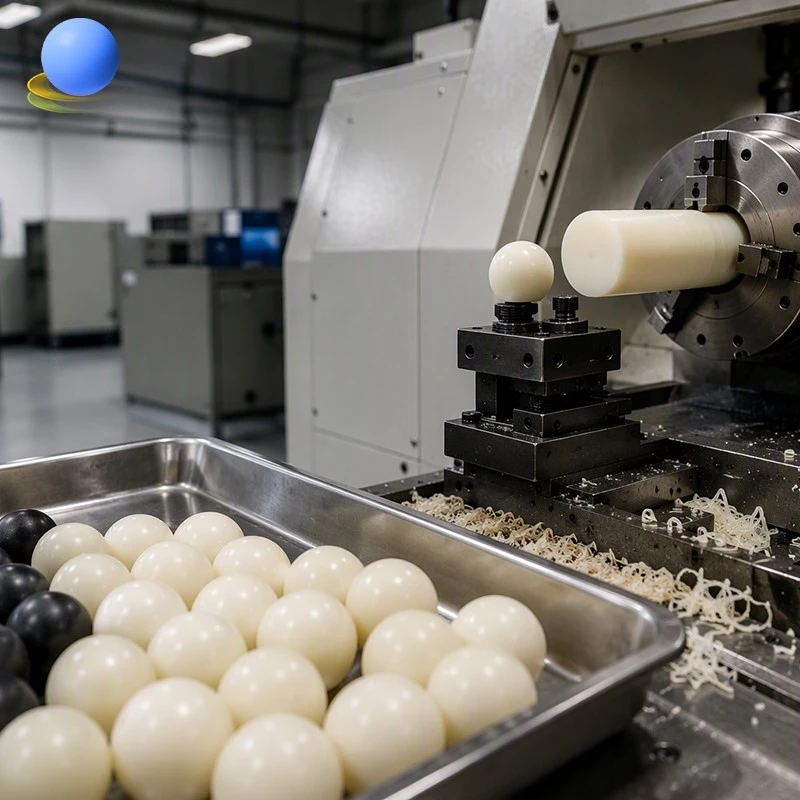
What moisture actually does to a nylon ball
Three effects matter in service, and all three trace back to the same mechanism.
The ball grows. Absorbed water occupies space between the polymer chains. As moisture content rises, the part swells. For a precision ball, growth means the fit changes - in a low-clearance seat, growth means interference; in a free-rolling position, growth means a different rolling diameter and different wear behaviour.
The material gets softer and tougher. Absorbed water acts as a plasticiser in polyamide. This is not a defect - conditioned nylon is tougher and less brittle than dry nylon, which is precisely why vehicle and industrial nylon components are specified in the conditioned state, not the dry state. But it also means that a tensile strength figure quoted from a datasheet is only meaningful if you know which condition it was measured in. Dry-state and conditioned-state values for the same grade are not the same number.
The dimension moves after the metrology. A dimensional report describes one instant. On hygroscopic material, that instant is only reproducible if the moisture content at measurement is defined and stated. Two suppliers can both report 4.763 mm and both be accurate, and still ship balls that behave differently.
How we handle it: define the condition, then define the size
The process sequence for nylon balls differs from POM or PTFE at exactly one point, and that point is where the tolerance lives.
Nylon balls are brought to a controlled moisture condition before final sizing and measurement, rather than being ground to final size in the dry-as-moulded state and shipped. This matters because dry-state nylon is at one end of its dimensional range. If a ball is ground to nominal while dry, it will exceed nominal once it equilibrates, and the tolerance that was carefully held in the inspection room is spent before the customer opens the carton.
Every nylon batch is therefore reported on parameters that include the condition under which it was measured:
Diameter and tolerance class, as measured
Moisture condition - the state the ball was in when measured
Roundness - the parameter that controls seat sealing on a soft, swelling material
Surface roughness
Lot-to-lot size variation - whether ball 5,000 matches ball 50
A pre-production sample is approved before mass production, and final inspection is completed before shipment.
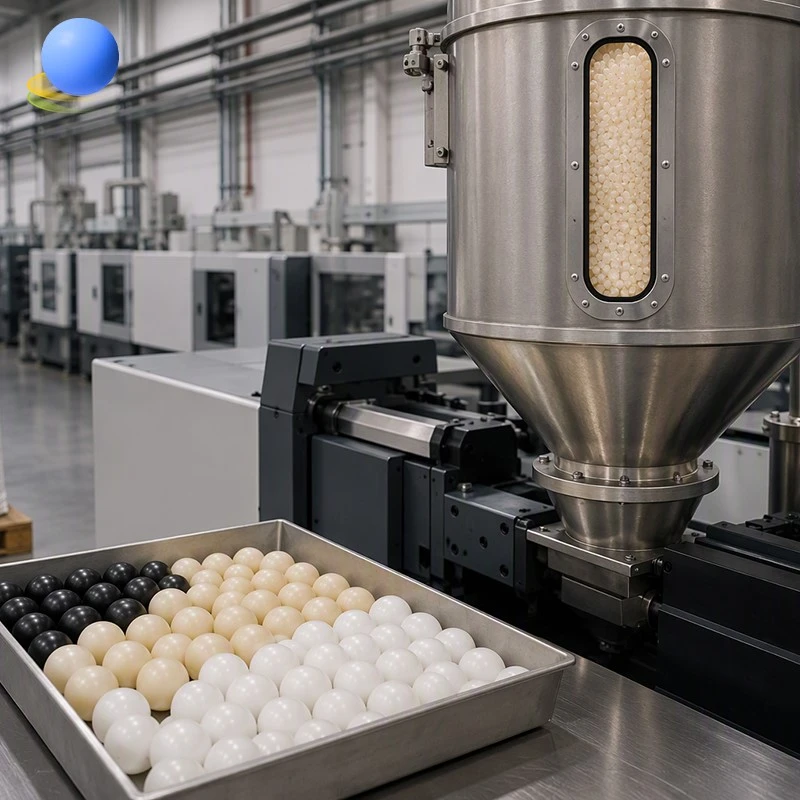
PA6 or PA66: the grade decision
Both are polyamides. They are not interchangeable, and the choice affects temperature rating, stiffness and toughness.
| Melting point | ~220 °C | ~255 °C |
| Stiffness and creep resistance | Lower | Higher |
| Toughness and impact resistance | Higher | Good |
| Surface finish and processing window | Easier to achieve a clean surface | Narrower window |
| Moisture behaviour | Highly hygroscopic | Highly hygroscopic - absorbs more at saturation than cast PA6 |
| Typical fit | Toughness-critical, impact-loaded positions, general bearing and roller duty |
Higher stiffness and temperature, general purpose precision balls |
Where a part needs more stiffness than either can give, glass-reinforced grades exist - but glass fibres are abrasive to mating surfaces, so reinforced nylon is generally the wrong choice for a sliding or rolling ball position. If a nylon ball is wearing its seat, the answer is usually a different material rather than a harder nylon.
What nylon is genuinely better at
Nylon balls earn their place in three situations, and it is worth being precise about them:
Unlubricated bearing and roller duty. A dynamic coefficient of friction of 0.26 (ASTM D3702, 40 psi at 50 fpm) on a material that is tough rather than brittle makes nylon balls well suited to low-speed, unlubricated rolling positions where a brittle polymer would chip.
Impact and shock loading. Where a ball has to survive being dropped, vibrated or slammed into a seat, toughness matters more than stiffness.
Contact with oils, greases and fuels. Nylon tolerates hydrocarbons well, which is why polyamide components appear widely in automotive, agricultural and conveyor equipment.
Add low density at around 1.14 g/cm³ and nylon becomes the right answer where the ball must be light and tough at the same time.
Where nylon is the wrong answer
Four checks settle it, and we raise them before quoting:
Strong acids, phenols or formic acid - polyamide degrades. Specify PTFE or PP.
Continuous service above 85 °C - PA66 is rated 85 °C long term and 149 °C intermittent. A buyer who sees 255 °C on the datasheet and assumes a 255 °C service capability has misread the number that governs the design. Above 85 °C continuous, specify PEEK.
The dimension has to be stable through humidity swings - this is nylon's defining weakness. If the fit cannot absorb a percent of dimensional movement, specify POM, PTFE or PEEK and accept the trade.
The application needs tight clearance and long storage before use - either condition the balls and specify the conditioning, or choose a non-hygroscopic material.
In each of these cases we will say so rather than sell the order.
Large-diameter nylon is a separate capability
Small nylon balls are widely available. Large ones are not, because swelling, creep and internal stress all scale with section thickness.
We produce PA66 balls in diameters up to 50 mm - a capability the factory reported publicly in July 2026 - and quote nylon across 2 mm to 100 mm at grades G0–G3. Buyers needing a large-diameter polyamide ball should ask for the roundness report as well as the diameter, because on a large nylon sphere those two numbers can diverge more than on any other material in the range.
The claim we are prepared to be judged on
We are not going to tell you we make the best nylon plastic balls in the world. Nylon is the only material in our range where the ball can be correct when it leaves us and wrong when it arrives, and any supplier who has not thought about that is not measuring the right thing.
What we will do is tell you the moisture condition behind the numbers on the report, tell you where nylon is the wrong material, and send a sample for you to test in your own seat or roller assembly before you commit to a volume order.
Free samples, 2–3 day lead time, freight collect. Sizes from 2 mm to 100 mm, grades G0–G3.
If a competing ball fits better in your hardware, you have lost nothing but the freight.
Capacity and documentation
Production runs from two plants - Henan Province, covering 10,000 m² with more than 200 machines, and Shandong Province, covering 5,000 m² with more than 50 machines, roughly 15,000 m² of combined manufacturing space. The two sites can take work from each other, so a loaded line does not move a delivery date.
The manufacturing base dates to 2004 in Ningyang, Shandong. Three entities operate together: Ningyang Xinxin Stainless Steel Ball Manufacture Co., Ltd (production, 2004), Taian Xinxin Import & Export Co., Ltd (export, 2012) and Henan Scole Industry And Trade Co., Ltd (manufacturing and trade, 2016).
The plant holds ISO certification, and its plastic balls additionally hold an FDA certificate. PTFE solid plastic balls have been reported to pass EU REACH testing.
Nylon balls are produced alongside the full plastic range - POM (acetal, Delrin), PP, PA6, PA66, PTFE, PEEK, PS, HDPE, ABS and acrylic - and alongside stainless steel, glass, ceramic, tungsten carbide, aluminium, brass and copper balls from the same plants, so an assembly that mixes materials can be placed on a single order.
Common sizes are held in factory stock and dispatched in about four days after payment. Custom sizes and materials run 15–30 days. Minimum order quantity starts at 100 pcs for regular sizes. Payment terms include T/T, L/C, Trade Assurance, PayPal and Western Union, with loading at Qingdao, Shanghai or Ningbo.
FAQ
Are you a nylon plastic ball factory or a trading company?
A manufacturer. Production runs from two plants: Henan Province (10,000 m², 200+ machines) and Shandong Province (5,000 m², 50+ machines).
Why do nylon balls change size after production?
Polyamide is hygroscopic. PA66 absorbs around 2.5% of its weight in water at 23 °C and 50% relative humidity, and 8.5% at saturation (ASTM D570). Absorbed water swells the part, so the dimension changes with moisture content rather than staying fixed as it does on POM or PTFE.
How do you hold G0–G3 tolerance on a material that absorbs water?
By defining the moisture condition first and sizing second. Balls are brought to a controlled moisture condition before final sizing and measurement, and the moisture condition at measurement is stated in the batch report.
Should we specify PA6 or PA66?
PA66 has a higher melting point (~255 °C vs ~220 °C), higher stiffness and better creep resistance. PA6 is tougher and easier to finish cleanly. Where the ball takes impact, PA6 is often the better choice; where it needs stiffness and temperature resistance, PA66.
What is the maximum service temperature for a nylon ball?
85 °C continuous, 149 °C intermittent for PA66. Despite a melting point of 255 °C, the long-term service temperature is the number that governs design.
What sizes do you produce in nylon?
2 mm to 100 mm in PA6 and PA66, at grades G0–G3 corresponding to ±0.01 mm to ±0.05 mm diameter tolerance. Large-diameter PA66 balls up to 50 mm are an established capability.
What are the main limitations of a nylon ball?
Moisture-driven dimensional change, a continuous service ceiling of 85 °C, and degradation in strong acids, phenols and formic acid. Nylon is also softer than POM, so abrasive service shortens life.
Do you supply samples before an order?
Yes. Samples are free of charge with freight at the buyer's cost, on a 2–3 day lead time. Custom sizes are sampled and approved before mass production.
What is the minimum order quantity and lead time?
MOQ from 100 pcs for regular sizes. Stock sizes dispatch in about four days; custom production runs 15–30 days.
Which markets do you export to?
The United States, Germany, France, the United Kingdom, Italy, Belgium, Spain, Brazil, Thailand, Vietnam, Saudi Arabia and Poland, among others.
About Us
Ningyang Xinxin Stainless Steel Ball Manufacture Co., Ltd began ball production in Ningyang, Shandong in 2004. The group today manufactures solid plastic balls (POM, PP, PA6, PA66, PTFE, PEEK, PS, HDPE, ABS, acrylic), plastic coated steel balls, stainless steel balls, glass balls, ceramic balls, tungsten carbide balls, aluminium balls, brass and copper balls, hollow plastic balls and stainless steel tumbling media from two plants in Henan and Shandong provinces, China.
Factory address: Xiangfu district, Kaifeng city, Henan province, China.
Email: info@xxballs.com
WhatsApp / Phone: +86 186 0548 6984 (Kerry)
Website: https://www.pomplasticball.com/solid-plastic-ball/nylon-plastic-ball/


